Free Wi-Fi, charging stations sprout in typhoon-hit communities in NegOcc
By Erwin P. Nicavera
BARELY two weeks after the onslaught of Typhoon Odette, many areas in Negros Occidental are still creeping in the dark as power connections have yet to be fully restored.
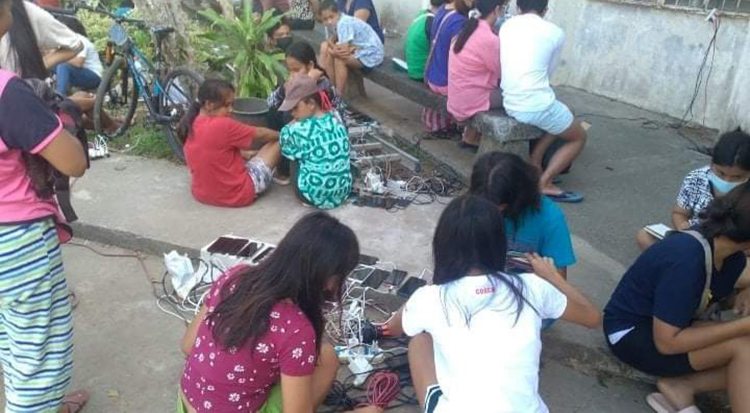
As power remained a problem in the province, which was already placed under a state of calamity, many free charging stations sprouted.
Worth noting, these efforts are mostly initiated by residents who were also affected by the typhoon and whose communities were devastated by the recent calamity.
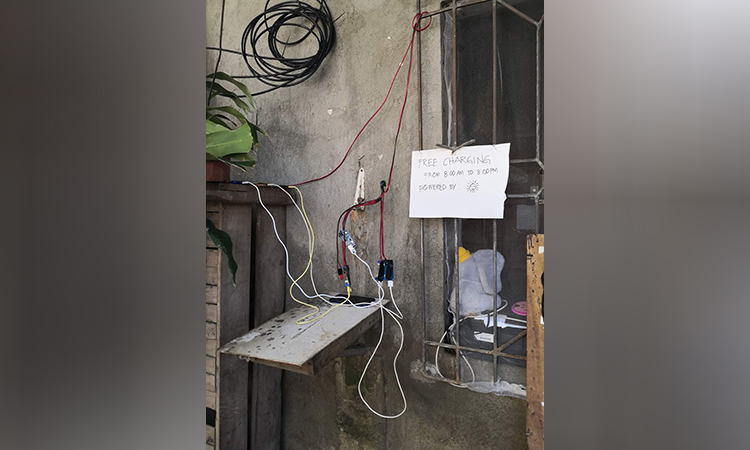
In Ilog town, 31-year-old Chester Keith Cabreros took to social media to call for donations of solar panels, which he can use to set up a free charging station at their residence in Barangay Andulauan.
“Fortunately, one of my officemates provided a 100-watt secondhand solar panel and charge controller,” he told SunStar Bacolod.
Cabreros improvised the battery of his motorcycle for storage so they can still charge during cloudy days. He also used a 12v-5v buck converter from the parts of his pisonet.
On December 24, he was able to open his free charging station with seven buck converters to his neighbors.
“I really worked hard to set up a free charging station because for one, some of those with generator set in our barangay are collecting P20 per charging,” Cabreros said, adding that “the amount is an additional burden to us residents especially during this calamity and pandemic.”
Barangay Andulauan in the southern Negros Occidental locality was submerged to flood water for several days following Odette’s onslaught.
Many of the houses, including that of the family of Cabreros, were destroyed and damaged.
In fact, his peso Wi-Fi business was also affected as some of the units were also damaged by the flood.
Aside from the free charging station, Cabreros also gave some of his buck converters to neighbors who have motorcycles so they can also charge their gadgets at their respective homes.
“We were all affected by the typhoon. In times of disasters and calamities, it is us who will help each other,” he said.
Given the limited power supply, Cabreros would only turn his Wi-Fi modem on if needed. He also shares internet access to neighbors who need to communicate to their families and relatives.
“Communication is very important during this time, especially in asking for help. But without electricity, it is very hard for us to have internet access,” he added.
In Bacolod City, many private establishments and residences also opened their doors to residents who need to charge their mobile phones and other gadgets.
A day after Odette hit Negros Occidental, hundreds flocked a mall in the city that offered free charging outlets.
Locals were allowed to bring extension cords and charge their gadgets, power banks and even appliances inside the mall.
In other towns and cities, local government units (LGUs) also set up free charging stations in public places like city and town halls, plazas, gymnasiums and barangay halls, among others.
In terms of power restoration status, only 90 percent of the areas catered by Northern Negros Electric Cooperative (Noneco) has been restored.
The power distribution utility is eyeing to fully energize the entire northern portion of the province, from E.B. Magalona to San Carlos City, before the week ends.
For the cities of Bacolod, Bago, Talisay and Silay, and towns of Murcia and Salvador Benedicto which are being serviced by Central Negros Electric Cooperative (Ceneco), the utility has yet to restore power in about 15 percent of the areas it covers.
In the southern part of the province, the most hardly-hit by the typhoon, about 30 percent of the feeders of Negros Occidental Electric Cooperative (Noceco) are still not energized as of Monday, December 27.
In Sipalay City, all 17 barangays are still experiencing a blackout since the onslaught of Typhoon Odette on December 16, 2021.
For 21-year-old Wil Villena, a resident of the city’s Barangay 5, the absence of power is making it difficult for the locals to ask for help.
At the same time, it is hard for the help to reach them, Villena said.
“At first, we could not immediately inform authorities about the situation on the ground because our communication lines were cut, our phone batteries were empty,” he lamented.
Personally, the power outage has affected Villena’s online classes.
He is currently taking Bachelor of Arts in Mass Communication at the University of St. La Salle – Bacolod.
“Good thing, the school has allowed extensions on the submission deadlines of our school works and other requirements,” Villena said, adding that it is also a huge challenge for him to perform his duty as a news stringer of a television network.
Without electricity, he could not be able to take photos and videos using his mobile phone.
It is even more difficult to send the materials to their station based in Bacolod City as there’s no internet connection.
Villena started to feel a relief when free charging stations also began to sprout in their community.
Aside from those established by the city government ang barangay councils, he said, some households with generator sets also provided free charging to the residents.
“Although there are many free charging stations in the city now, these are still not enough to address the demand for electricity of the many residents,” Villena said, adding that the “bayanihan” spirit is alive in Sipalay City not just through the relief goods being sent to the affected residents.
“The spirit of helping one another is also evident among houses opening their doors to their fellow Sipalaynons and sharing to them the power that they also need during these very trying times,” he also shared.
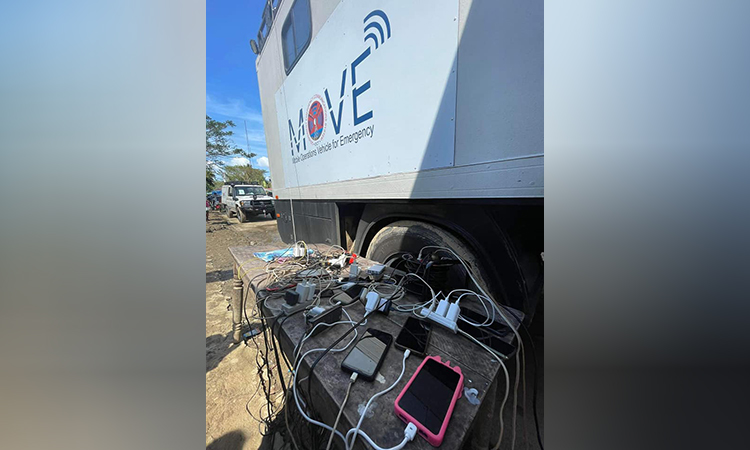
Recognizing the importance of power and connectivity in the midst of disaster and calamity, the Department of Information and Communications Technology (DICT), through the Government Emergency Communications System (Gecs) project, has deployed one Mobile Operations Vehicles for Emergency (Move) unit in Sipalay City on Monday.
The DICT leads the Emergency Telecommunications Cluster (ETC) of the National Disaster Risk Reduction Cluster in the pursuit of establishing critical communications lifelines in times of disaster.
Through the Gecs, the agency strengthens the government’s capacity in disaster preparedness and response.
Being one of the hardest-hit localities in Negros Occidental, Sipalay City can now avail its “KonekTawag Services” including free charging, free calls, and free chat and video calls using its free Wi-Fi.
Elmer Prudente, chief of the Technical Operations Division of DICT-Western Visayas, told SunStar Bacolod that the Move unit is strategically dispatched in different barangays in the city every day.
Prudente said the free Wi-Fi does not have a password or access code so residents can immediately connect.
Though in limited bandwidth, they can make messages and calls through various social media applications.
Using Very Small Aperture Terminal (VSAT), the unit can cater to an average of 100 gadgets at a given time.
A monitoring team is making sure that the services are being used for important purposes only, the official said, adding that downloading of heavy files and applications are prohibited.
The “KonekTawag Services” can be availed by the residents 24/7 and the mobile operations vehicle will stay in Sipalay until the city is fully energized.
Stressing the importance of connectivity in times of disasters and calamities, Prudente said the agency’s Move unit enables typhoon-hit residents to communicate with their friends, relatives and family informing them that they are safe.
The DICT official said this can also help people in asking for help, especially through social media, enable the government to continue its information dissemination efforts, and contribute in implementing response measures like gathering of data and reports.
On top of the Move unit in Sipalay, the DICT also deployed seven generator sets to other affected areas in the province including Isabela, Ilog and Kabankalan City.
“There is a need to also prioritize restoration of power and communication lines in areas stricken by typhoons so the delivery of help and services is not hampered,” he said, adding that the internet, particularly connectivity, can also be considered as a “basic necessity” during calamities.