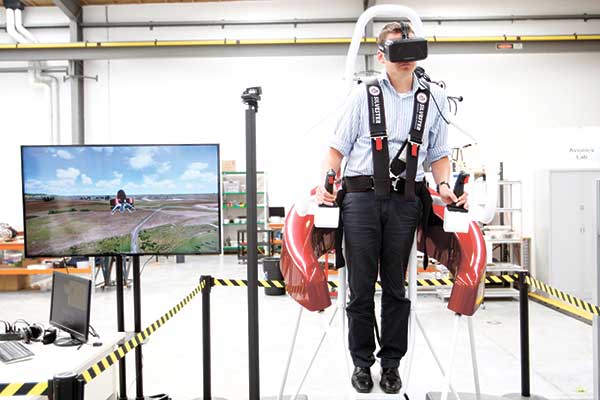
A jetpack nears liftoff, but creator fears dream is grounded
CHRISTCHURCH, New Zealand — Glenn Martin was sitting in a bar with his college buddies 35 years ago when they got to wondering: What ever happened to flying cars and jetpacks?
The next day, the New Zealander began looking for answers in the science library, triggering a lifelong quest to build a jetpack. But today, with the company he created seemingly on the verge of triumph, Martin worries his dream is slipping away.
Martin Aircraft Co. says it will deliver its first experimental jetpacks to customers this year, a big development for the new technology. But the jetpack is being designed for first responders like firefighters, an outcome that falls short of Martin’s vision of a recreational jetpack that anybody could fly.
The inventor has now left the company he founded. What’s more, he says, he’s asked for his name to be removed.
“All us guys know what a jetpack’s for,” he says with a smile at his Christchurch home. “With a jetpack, you save the world and you get the girl. Right?”
Jetpacks have often been portrayed that way in books and movies. They have formed part of humanity’s utopian future vision for the past century. Fictional characters from Buck Rogers to Elroy Jetson have used them, and a real jetpack wowed the crowds at the opening of the 1984 Olympic Games in Los Angeles.
Martin, 56, grew up in the South Pacific, thousands of miles (kilometers) from Houston. But he followed the space race avidly.
“I still remember sitting in class and listening to Neil Armstrong step onto the moon,” he says. “And I believed, I suppose, that we would all have flying cars and jetpacks and bases on Mars by the time I was an adult.”
Storied though they may be, jetpacks have a troubled history. The Bell Aerospace rocket belt, developed in the 1960s, showed it was possible. However, that jetpack couldn’t carry much weight and could remain airborne for less than 30 seconds. It was for show, nothing more.
In the mid-1990s, three Houston men decided they’d try to make one. Instead, they made a mess. They fell out over money and their venture ended with an unsolved murder, an abduction, a man in jail and a device that had vanished.
Peter Coker, Martin Aircraft’s chief executive, says he believes the best business plan is to make jetpacks for first responders and later for other commercial operators. Once all the supply chains are in place, he says, the company can then turn its attention to building a personal jetpack.
“We are now an aviation company,” Coker says. “Before, it was very much the kiwi dream. But you have to take that commercial path.”
Glenn Martin’s vision still holds true, Coker says: Creating and selling a personal jetpack remains part of what the company is all about.
But Martin doubts the company will ever make one.
Obstacles remain. The jetpack will need to be cleared by aviation authorities. Martin Aircraft has been working with New Zealand’s Civil Aviation Authority on a new category for jetpacks, which Coker hopes will provide a template for other nations.
“Jetpacks are a funny thing. They create a lot of passion,” Martin says. “Everybody loves the idea of a jetpack. But the reality is that it’s a lot of hard work.”
The jetpack may look bulky, but Martin says you don’t notice that when you’re airborne — an experience he likens to living out his childhood dreams.
“The jetpack is all behind you. You can’t see it,” he says. “All you can see is your hands. It’s like some magic hand has lifted you up, and you’re flying.” (AP)